

Trailer Brake Selection Mistakes Custom Builders Should Avoid
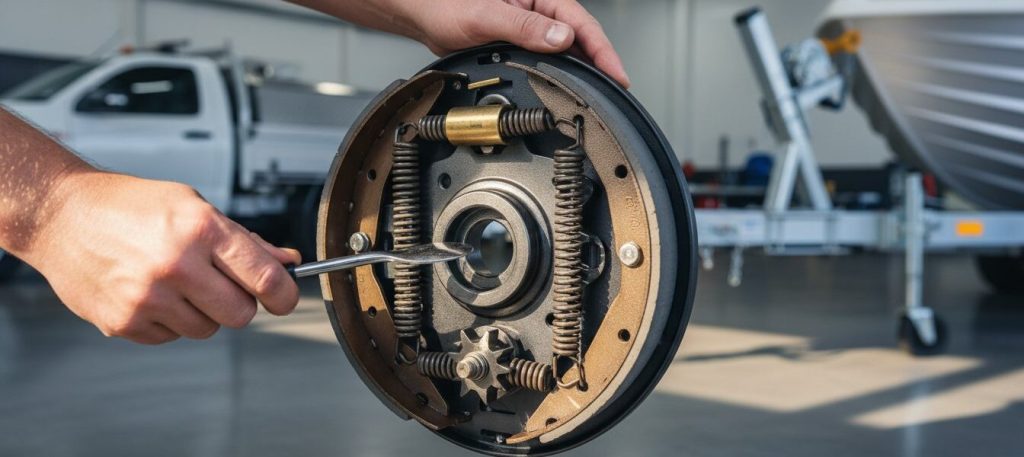
Trailer brake selection starts with the trailer’s documented design, and the numbers on that paperwork leave little room for guesswork. The plated mass, axle ratings and coupling capacity set the frame for every component choice that follows, and a professional assessment confirms what the build actually needs before parts are ordered. Getting the parts specification right before the first weld can help prevent problems at inspection and on the road.
Miscounting the loaded weight
Aggregate Trailer Mass, or ATM, is the total weight of the trailer fully loaded, and it includes the downward load on the tow ball. Gross Trailer Mass, or GTM, is the weight the trailer’s own tires carry while coupled. The two figures sound similar, but they are used for different calculations.
The miscount usually starts on a workshop scale. A builder weighs the bare chassis, adds the axles and coupling, and orders brakes for that total. Water tanks, toolboxes, spare wheels and the payload itself arrive later, so the finished trailer rolls out a tier higher than the brakes were chosen for.
The loaded figure is the one that counts, and it rarely matches the bare chassis weight recorded at the start of a build. Work from documented design requirements for the finished trailer, with every tank, toolbox and payload item accounted for before brakes are specified.
GTM sets the load each axle and brake assembly must carry. Weigh the trailer with its full payload, or add a working margin before ordering any brake component.
Choosing a system that doesn’t fit the weight class
Hydraulic override brakes are the simple option at the lighter end. The trailer pushes against the coupling as the tow vehicle slows, and that mechanical force actuates the brakes with no wiring and no in-cab controller. Override systems also need a reverse lockout, because backing up pushes the coupling the same way braking does.
The ceiling on that simplicity is firm, and the exact threshold depends on the rules where the trailer will be registered. Above it, the trailer needs brakes on all wheels that the driver can operate from the seat. The safest approach is to choose the brake architecture with a qualified builder, using the trailer’s actual design documents and avoiding assumptions about its weight class. Those documents show the rated ATM, axle loading and coupling specification that determine which system the law requires.
That requirement leaves two realistic paths. Electric drum brakes paired with an in-cab brake controller suit most heavy box, car and plant trailers. Electric-over-hydraulic (EOH) systems, where an in-cab controller drives a hydraulic actuator that feeds the disc calipers, suit heavy tandems that need stronger and more consistent stopping power.
Override costs less and asks nothing of the tow vehicle, but it gives the driver no way to adjust braking force. Electric systems need a compatible controller and wiring, and they let the driver tune the trailer’s braking to the load.
Skipping the breakaway system
Heavier trailers call for a second device: the breakaway system. If the trailer separates from the tow vehicle, the unit applies the trailer’s brakes automatically and holds them until someone can secure the rig. That hold runs on an onboard battery, so the right unit and battery setup depend on the trailer’s actual design, and a qualified brake specialist should specify both.
The hardware is simple. A cable clips to the tow vehicle, separation pulls a pin from a switch, and a battery on the trailer powers the brakes. Installations often fail at the battery: it needs its own charge circuit, and many standards call for an in-cab monitor so the driver can see its state. The switch and cable need a mounting point that pulls the pin cleanly at any angle of separation.
A breakaway unit with a flat battery cannot do its job.
Builders get caught two ways here. Some leave the system off entirely and discover the omission at inspection. Others fit it without a way to charge or test the battery and risk a system that fails when it is needed.
Buying on price and skipping serviceability
The right system can still be undone by cheap parts. Unbranded backing plates, magnets and drums often use inconsistent metallurgy, and under hard use the result is thermal cracking and uneven braking force from wheel to wheel.
The initial saving is small compared with the cost of failure. A cracked drum on a loaded tandem can destroy the hub and score the axle stub, leaving the trailer sitting until parts arrive.
Serviceability deserves the same attention as the initial specification. Brake magnets and shoes are wear items, and they should be easy to identify by axle rating and brake size. Magnets wear against the drum face on every application, so they are consumables by design. A catalog of trailer spare parts is useful for researching what replacements exist, and builders should record the actual part numbers and brake dimensions at the time of the build.
Branded assemblies come with published part numbers, and generic ones frequently do not. Builders who save a small sum on odd-size or unbranded hardware can strand the trailer a decade later, when no replacement exists and a full axle swap becomes the only option.
Ignoring where the trailer will work
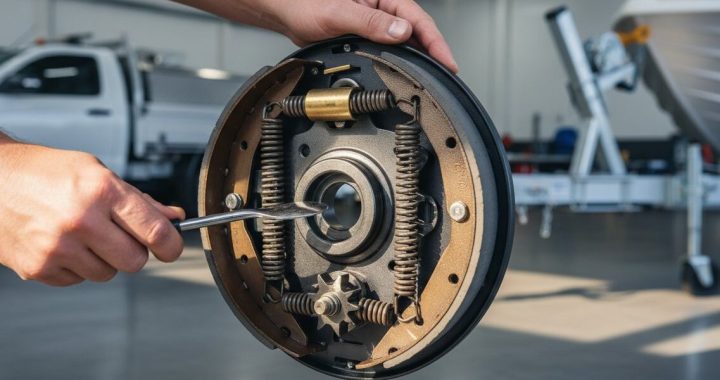
Even well-made parts fail in the wrong setting. Standard electric drum brakes and salt water do not mix. An electric drum works by energizing a magnet that drags on the drum’s inner face to apply the shoes, and every boat launch fills that drum with water. The magnet and spring assembly corrodes, and the brake seizes.
Off-road builds have the same problem with different material. Mud and dust pack into the drum, the abrasive paste wears magnets and shoes fast, and the first sign is usually a wheel that drags or does nothing.
Marine trailers belong on disc brakes with corrosion protection. Many off-road builds suit them too, though electric drum brakes made for off-road use are another option. Dacromet-coated discs and stainless steel calipers survive repeated immersion, and hot-dip galvanized hardware holds up where painted steel flakes. Discs also shed water and grit, and the pads and calipers can be inspected without pulling a hub. Galvanized hubs and rotors cost more at ordering and less at the first service.
The choice shows up two seasons in. A boat trailer on the wrong brakes needs a strip-down and replacement hardware, while a protected disc setup needs a rinse and a pad check.
Mismatching axles, brakes and suspension
Matching does not end with the brake assembly. Every axle carries a load rating, and the brake assembly behind it has a capacity of its own. A heavy-duty axle paired with an undersized brake forces hardware that cannot shed heat to do the stopping. The axle’s rating is stamped on its plate, and brake capacity should be checked against that figure.
Heat causes the failure. An overworked brake fades on long descents and cracks under repeated heat cycles. Wear can be fast, and because the decline is gradual, the mismatch can go unnoticed until a fully loaded run exposes it.
Tandem builds add a second problem. Without load-sharing suspension, the axles do not carry equal weight through dips or under braking. One axle can unload and lift slightly in a hard stop, its wheels lock and flat-spot the tires, and the other axle is left doing most of the work.
Load-sharing designs link the axles so weight transfers between them over uneven ground, which keeps each brake doing its share. On a custom tandem, the suspension choice belongs in the braking calculation from the start.
Forgetting the tow vehicle
The tow vehicle is part of the matching job. An EOH setup depends on the controller driving it. Many basic in-cab controllers cannot run an EOH actuator, and a mismatch shows up as lag when the driver brakes or a violent grab when the signal catches up. Some controllers need an EOH mode selected in their settings, and skipping that step mimics a hardware fault.
Electric drum systems are more forgiving, but they still need to be matched. Modern controllers are proportional: they apply the trailer brakes in step with the tow vehicle’s deceleration, and each unit is rated for a set number of braked axles. A controller set up for one braked axle will not run two properly.
Cable size belongs in the same conversation. Undersized wiring drops voltage along a long drawbar, and the rear axle’s brakes end up weaker than the front pair. Automotive-grade sealed connectors with proper strain relief cost little and prevent quiet failures. A corroded plug stops a brake just as a failed magnet does. A voltage check under load can help identify wiring faults before the trailer leaves the yard.
The controller should be specified with the trailer, and the owner should receive the exact setup details. Correct settings on day one help the trailer brake straight and predictably.
Treating lines and wiring as an afterthought
The braking system reaches the wheels through hydraulic lines and wiring, and both run under the trailer in the path of road debris. Suspension movement and exhaust heat cause slower damage.
Protecting them is cheap and specific: clips at short intervals, grommets at every chassis pass-through, heat shielding near the exhaust and slack where the suspension cycles. Corrugated conduit costs little and outlasts tape and zip ties. Where lines cross an axle, they should move with the axle and not the chassis.
A brake line rubbed through at highway speed can remove braking from one axle or from the whole trailer, depending on the plumbing. A chafed wire gives no warning, and the driver finds out on the first hard stop.
These details may not show in workshop photos, but they matter years later, when the owner has long stopped thinking about the brakes.
Brake selection rewards careful arithmetic. An accurate weight figure sets the tier, and the tier sets the system. The trailer’s working life should then set the hardware, from the coating on the discs to the part numbers on the magnets. Builders who work in that order rarely have to redo any of it.
 Car Servicing Mistakes That Can Lead to Bigger Repair Bills
 The Complete Guide to Buying a Bespoke VW Motorhome
 KAIYI Auto Hosts 2026 Global Business Conference, Entering a New Phase of Global Expansion
 Truck Showdown in Florida: Owner-Loved Winners and Regretted Losers
 How to Get a Light Forklift Licence in Dubai: Everything You Need to Know
 How DC Chargers Are Shaping the Future of E-Mobility
 Trailer Brake Selection Mistakes Custom Builders Should Avoid